

Non-Doms and Share Exchanges
Despite wide speculation as to whether the non-dom regime would survive the Budget, in fact the regime received no comment at all (other than by the Shadow Chancellor!).
There was, though, a tweak to the rules in relation to share for share exchanges as they apply to non-doms. The point is that before this change, all individual taxpayers (including non-doms) undertaking certain share for share transactions may be able to do so on the basis that the new shares take on the base cost of the old shares, without a capital disposal being considered as taking place. However, if the shareholder is a non-dom and the new shares held are in an offshore company, potentially the gain on those new shares may be able to go untaxed when later disposed of. Following these changes, the shares in the new non-UK holding company are treated for capital gains tax purposes as being UK assets, meaning the remittance basis will not be available on the eventual sale of the shares. It is possible to dis-apply the share-for-share exchange rules, meaning that the gain on transferring to a non-UK holding company is taxed at that time, but any subsequent increase of value could be subject to the remittance basis.
Interestingly, the new rules for share for share exchanges for non-doms represent the only policy released with any degree of detail (including draft legislation). The non-doms caught by these new rules will be individuals with at least a 5% holding in a UK incorporated trading company who are looking to hold the business through a non-UK incorporated company. The new rules also only catch close company situations. One wonders how truly necessary the tweak was as anyway, HMRC would often be slow to accept that such share for share exchanges were undertaken for non-tax reasons (in which case share for share treatment for tax purposes could not apply).
Alongside this change is a similar provision to ensure that, if these rules apply for capital gains tax purposes, dividends from the new holding company do not qualify for the remittance basis and so are fully taxable in the UK (unless the rules are disapplied by election of the taxpayer as mentioned above). This could potentially catch a much wider net of dividend income, if the foreign holding company anyway had other foreign subsidiaries in addition to the new UK subsidiary. For this reason in particular, the disapplication of the new rules (and alternative acceptance that the disposal of the UK company shares is charged to UK capital gains tax) is likely to be a key consideration going forward.
This change does not impact the inheritance tax rules so the shareholder would hold a non-UK situs asset after such an exchange (though of course trading companies may well qualify for relief anyway).
Personal Tax Changes
As well as freezing the income tax personal allowance, higher rate tax and inheritance thresholds until April 2028, the threshold at which the 45p rate of income tax is charged will be reduced from £150,000 to £125,140. Those earning over £150,000 will therefore pay an extra £1,243 per year.
Other announcements include:
- Reducing the dividend allowance from £2,000 currently to £1,000 in 2023/24 and £500 from April 2024.
- A reduction of the annual exemption for capital gains tax purposes from £12,300 currently to £6,000 in 2023/24 with a further reduction to £3,000 with effect from April 2024.
Arguably, it is these adjustments that will have the biggest impact on those with lower income and modest capital gains, and will no doubt bring more people into the self assessment regime.
In fact, when the now disbanded Office of Tax Simplification reviewed the capital gains tax regime a few years ago, it was estimated that reducing the annual exemption (albeit to a lower amount than has been announced today) would bring more than 250,000 taxpayers into the self assessment regime. Many unrepresented taxpayers making chargeable disposals may now fall foul of their compliance obligations where the amount of the chargeable gain is relatively modest.
To illustrate the point we can look at the case study of Mrs C, who receives state pension, a small private pension and modest investment income. She makes gains on the disposal of shares of £12,000, which would currently be within the capital gains tax annual exemption.
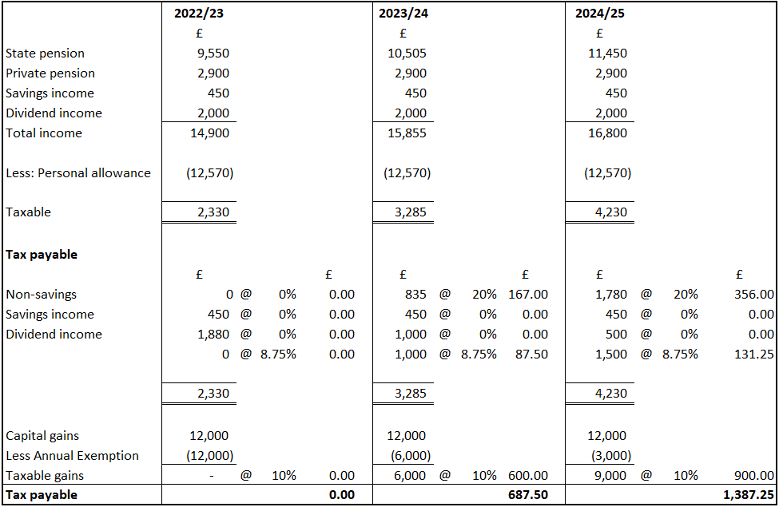
For the purposes of the calculation, we have increased the state pension by 10% for the year to 5 April 2024 and then 9% for the year to 5 April 2025 in line with the announcement that state pensions will increase with inflation, though of course this is just for the purpose of the example.
In the current tax year, Mrs C would have no obligation to complete a tax return and she does not have any tax liability. By reducing the dividend allowance and capital gains tax annual exemption it can be shown that with the same levels of private pension, investment income and gains, she would be brought into the self assessment regime, and have a tax liability of £687.50 in the 2023/24 tax year, increasing to £1,387.25 in the following tax year.
Business and Employment Taxes
As well as announcing the measures above that will impact the ‘ordinary’ taxpayer, readers will be pleased to know that the government has also announced further measures that should increase the tax uptake from multinational business with a presence in the UK, and energy companies that are benefitting from record-making profits. There are also changes to the Research and Development regime to reduce the level of fraudulent claims in future.
Diverted Profits Tax (DPT)
Now that the main rate of corporation tax is again set to rise to 25% from 1 April 2023, DPT will also increase to 31% from the same date. This is to maintain the 6% difference between corporation tax and DPT. DPT is a separate tax from corporation tax, and was introduced in 2015 with the aim of deterring large multinational groups from diverting profits away from the UK using contrived arrangements.
Energy Profits Levy
The Chancellor also announced that the windfall tax on energy companies will increase to 35% from 1 January 2023, from the current rate of 25%. The levy seeks to raise additional tax revenue from the extraordinary profits that energy companies are currently benefiting from, and will stay in place until March 2028 (a three year extension from the original proposals).
An additional levy aimed at low-carbon electricity generators in the UK will also be introduced from 1 January 2023, and will be payable at a rate of 45% by the largest electricity generating businesses that have seen extraordinary returns.
Minimum corporation tax for large groups and multinational groups
In a global bid to ensure that large multinational groups pay their fair share of tax across the world, the G20 has previously announced measures to ensure such groups pay a minimum rate of corporation tax of 15% in each jurisdiction that they operate in.
From 31 December 2023, the government will introduce two additional ‘top-up’ taxes with the aim of ensuring that multinational groups that have their headquarters in the UK, or large groups with operations in the UK, have an effective tax rate of 15%.
A third ‘backstop’ tax will also be introduced from 31 December 2024 to capture situations not already covered by the first two rules.
Research and Development (R&D)
The UK operates two different R&D incentive schemes, one aimed at Small and Medium Sized Entities (SMEs) and another scheme aimed at larger companies.
SMEs
The SME scheme is aimed at groups of companies with less than 500 employees, and either turnover under €100 million, or gross assets under €86million. Previously, a company qualifying for the SME R&D relief could receive a deduction for corporation tax purposes of 230% of the R&D related expenditure (100% of the actual expenditure plus an ‘uplift’ of 130%). From 1 April 2023, the ‘uplift’ is being reduced to 86%, meaning a deduction of 186% of the R&D related expenditure.
As the main rate of corporation tax has been confirmed as rising to 25% for companies with profits over £250,000 (with a marginal rate between 19%-25% applying to companies with profits between £50,000 and £250,000), the reduction in the ‘uplift’ is more than offset by the increased tax rate for companies that will suffer the increased main rate of corporation tax
SMEs are also able to claim an R&D tax credit to generate a cash payment from HMRC – this is possible where an SME ‘surrenders’ certain losses in exchange for a payment from HMRC. Currently, the tax credit is based on 14.5% of the surrendered loss, but this will be reducing to 10% from 1 April 2023.
An example of the impacts is shown below:

Research and Development Expenditure Credit (RDEC)
The relief for companies that do not qualify for the SME regime operates on a slightly different basis, with relief currently given as a credit against the company’s tax liability at a rate of 13% of the qualifying expenditure, although the amount of credit given is also added to the company’s taxable profits. The rate of credit will be increasing to 20% from 1 April 2023.
As previously announced R&D tax reliefs will be expanded to include qualifying expenditure on data and cloud costs and refocusing support towards innovation in the UK. The government will also look at simplifying the R&D regime in future, with the potential introduction of a single scheme.
Annual Investment Allowance (AIA)
As previously announced, the annual investment allowance will permanently be set at £1million, rather than decreasing to £200,000 from April 2023.
AIA provides a 100% tax deduction for expenditure on qualifying plant and machinery, up to a specific threshold. That threshold has changed six times over the last 14 years but the government has confirmed the allowance will remain at £1million from now on.
First Year Allowance for Electric Vehicle Chargepoints
The 100% First Year Allowance for electric vehicle chargepoints will be extended to 31 March 2025 for corporation tax purposes and 5 April 2025 for income tax purposes.
Employment Related Measures
- The Employment Allowance for Employer’s National Insurance Contributions will remain at £5,000 per group.
- The Employer’s National Insurance Threshold will be frozen at £9,100 until April 2028.
- Company Car Tax Rates for electric and ultra-low emission cars will increase by 1% per year from April 2025 to April 2028, up to a maximum percentage of 5% for electric cars and 21% for ultra-low emission cars.
- Rates for all other cars will increase by 1% from April 2025, up to a maximum of 37%, and will be fixed until 5 April 2027.
Transfer Pricing Documentation
The government is introducing a prescribed and standardised format for transfer pricing documentation to provide clarity to large multinational businesses operating in the UK on the records they are required to maintain.
Transfer Pricing is formally required for companies that have more than 250 employees and either annual turnover over £10million or gross assets over £50million, and broadly requires adjustments to corporation tax returns where transactions with connected parties have not been undertaken on an arm’s length basis.
Other Announcements
- The VAT threshold will remain at £83,000 until 31 March 2026
- The government has announced a consultation on creative industry tax reliefs in the audio-video sector to incentivise the production of British film, animation, TV and video games. The review aims at ensuring that the UK’s creative tax reliefs are kept up to date with evolving technology and distribution models, and are straightforward to administer.
Please get in touch if you have any questions.
CHARTER TAX CONSULTING LIMITED
11 ST JAMES'S PLACE
LONDON
SW1A 1NP
advice@charter-tax.com
17 November 2022