

Charter Tax Consulting Ltd
Autumn Budget: 22nd November 2017
Client Summary Note
Introduction
The Chancellor seemed in particularly good form when delivering his Budget Speech today. Perhaps we didn’t quite understand all the “economicy words” (Hammond’s words, not ours!) but it seems to us that the deficit isn’t actually reducing as spending is still more than taxes raised. Anyway, as seems to be Hammond’s style, there were no great surprises in this Autumn Budget and he retains a positive outlook on the UK economy.
Although not really a surprise, given the recent negative press surrounding the “unfairness” of non-resident investors in commercial property not being charged capital gains tax on the property, our non-resident investor clients will still be disappointed to learn that the tax regime for UK immovable property owned by non-residents is receiving a further overhaul. Commercial property owned by non- residents will, from April 2019, fall within the capital gains tax net (residential property already does) and furthermore there will be a widening of the scope of the existing tax charges to non-residents owning UK residential property, including bringing the shares in “property-rich companies” into the UK capital gains tax net.
The likes of Amazon will also have to think very hard about how they organise their on-line sales going forward as they may now become jointly and severally liable for unpaid VAT liabilities arising from sellers using their services.
Reassuringly, the Chancellor confirmed his commitment to keeping a low corporation tax rate in the UK. He also acknowledged the role of small businesses in the UK and again committed to support the UK small business sector. Primarily this is in the form of reduced business rates but interestingly he also said he was not going to reduce the VAT registration threshold, despite some speculation as to whether he should.
Other than that, there is the usual raft of tightening of anti-avoidance legislation and tweaks to existing rules, although happily no further bad news for the non-doms (albeit there are some changes to the offshore trust regime that were pre-announced).
We have summarised below the main points in the Autumn Budget likely to affect our clients. If you would like to discuss any of these changes then please do not hesitate to get in touch.
Property Taxation
- Capital Gains made by Non-UK Residents on UK Immovable Property
- Non-UK Companies receiving Rental Income From UK Residential Property
- Capital Gains Tax Payment Window
- Stamp Duty Land Tax (SDLT) and Higher Rates Transactions
- SDLT: Relief for First Time Buyers
- ATED rates
Private Client
- Income Tax
- Certificates of Tax Deposits
- EIS and VCT Reforms
- Employees: Termination Payments – Removal of Foreign Service Relief
- Taxation of Offshore Trusts
- Other News
Company Taxation
- Employee Benefits
- Withholding Taxes
- Double Tax Relief
- Indexation Allowance
- Disincorporation Relief
- Research and Development Expenditure Credits
- Intangible Fixed Assets: related party step up Scheme
- Debts owed to HMRC
VAT
- Online platforms
- Construction Sector
- Threshold
Making Tax Digital
Multilateral Convention to Implement Tax Treaty Related Measures To Prevent Base Erosion and Profit Shifting
Anti-Avoidance
- Disguised Remuneration – a Further Update!
- Extending Offshore Time Limts
- Off Payroll Working
Property Taxation
Capital Gains Made by Non-UK Residents on UK Immovable Property
Over the past few years, there seems to have been an almost constant stream of tax hits imposed on non-UK residents owning UK residential property, starting in April 2013with the introduction of ATED and CGT on such property held through a company.
Although not specifically announced in his Budget speech today, as always, the “devil is in the detail” and amongst the Budget publications issued at the end of the Chancellor’s speech was a consultation document entitled “Taxing gains made by non-residents on UK immovable property”.
This document announces that the Government now intends, from April 2019, to target non-UK residents disposing of any type of UK property including, for example, offices, factories, shops, hotels and agricultural land (currently only residential property held by non-residents attracts a CGT charge on sale).
At the same time, they are also going to extend the scope of the existing rules for UK residential property to include indirect sales and disposals made by widely-held companies (which under current rules are not within the CGT charge).
Clearly both changes will have a significant impact on many non-UK residents.
Direct disposals
Individuals making direct disposals of UK property will be chargeable to CGT in much the same way as they already are for residential property, but with rebasing available at April 2019. Where a more beneficial result can be achieved by using the original acquisition cost, this can be substituted.
Where the non-UK resident is a corporate (whether closely- or widely-held), they will be chargeable to corporation tax with, again, rebasing at April 2019 available.
Any loss arising on the disposal of UK property will be available to offset against future UK property gains and those individuals who have existing losses that have arisen under the NRCGT regime for residential property will be able to use these losses against gains arising on non-residential property.
Businesses are currently able to defer gains by rolling-over gains made on certain business assets by reinvesting in new trading assets. HMRC propose to allow UK property gains to benefit from rollover relief where they qualify under the normal rules and requirements.
Indirect disposals
Where the disposal is not of the property itself, but a disposal of an interest in an entity that holds the property, any capital gain arising may be subject to tax.
Where the entity being disposed of is “property-rich” (i.e. at least 75% of its gross asset value at the time of sale comprises UK immovable property) and the non-resident holds a 25% or more interest in the entity at the date of disposal – or they have held such an interest at any point in the five years ending on that date - then the disposal is within the scope of the tax.
As with direct disposals, the property can be rebased at April 2019; however, unlike direct disposals, there is no option to substitute this with the original acquisition cost.
Impact of Double Tax Treaties
Many of the UK’s Tax Treaties with other countries have provisions in place that allocate the taxing rights to the UK where gains arise on the disposal of shares in UK property rich companies.
However, there are some Treaties where such provisions are not in place and, instead, taxing rights are given to the country in which the owner of the property-rich company is resident.
To catch such situations, the Government has introduced an “anti-forestalling” rule with immediate effect to prevent anyone impacted by this change putting in place any arrangements before April 2019 to avoid the new charge through treaty shopping arrangements.
This is part of HMRC’s wider work on Tax Treaties under the Multilateral Convention. These include putting in place minimum standards agreed by countries participating in the BEPS project in relation to preventing treaty abuse and improving dispute resolution.
Although the finer detail of the legislation changes for UK immovable property will be in consultation until mid-February 2018, if you think the changes are likely to impact on your tax situation and would like to discuss this with us, please get in touch.
Non-UK Companies receiving Rental Income From UK Residential Property
Currently, non-UK resident companies that receive rental income from UK property (whether residential or commercial) are subject to income tax.
From April 2020, such income will instead by subject to corporation tax, as will any gains that arise on the disposal of such properties. HMRC will consult on this further in summer 2018, at which point we will have more detail on this proposal.
Capital Gains Tax Payment Window
The Government have mentioned in the past that they were considering the introduction of a 30-day payment window where a capital gain arises on the sale of residential property, a system that has been in place for some categories of non-residents disposing of UK residential property since April 2015.
They have now announced that this will be deferred until April 2020 and we await more information.
Stamp Duty Land Tax (SDLT) and Higher Rates Transactions
Some of the criticisms of the application of the higher rates of SDLT are to be addressed in Finance Bill 2017-18 and which will make amendments to:
- Prevent relief from higher rates transactions where the whole of the former residence is not disposed of (or is disposed of to the purchaser’s spouse)
- Disapply higher rates SDLT where an individual buys property from their spouse or civil partner
- SDLT higher rates exemptions for certain adjustments to property ownership on divorce or dissolution of a civil partnership
- Make provision for certain situations where property is held for a minor under the Mental Capacity Act
These changes will not impact the vast majority of transactions, and will hopefully benefit genuine cases of need where a marriage or civil partnership comes to an end, or in providing for certain vulnerable children.
SDLT: Relief for First Time Buyers
In recognition of the difficulty first-time buyers have in getting on to the property ladder, and to assist them in reducing the financial cost of this, the Chancellor has announced a new SDLT relief for individuals purchasing property in England, Wales and Northern Ireland.
The relief is available with immediate effect and benefits those purchasing their first residential property with a value of up to £500,000, so long as it is intended to be used as the buyer’s only or main residence.
In such cases, the first £300,000 of the purchase price is completely free of SDLT, with a rate of 5% being applied for the amount above £300,000 where the purchase price does not exceed £500,000.
So, for example, if purchasing a property for £500,000, prior to today this would have resulted in SDLT of £15,000; from today the SDLT cost will be £10,000, so a saving of £5,000.
The relief can apply where there is more than one purchaser, but they must all be first-time buyers and they must all be intending to occupy the property as their own or main residence. They do not necessarily have to move in as soon as the purchase completes, but there must be a clear intention to do so.
Note that to be a first-time buyer, the individual must not have had a previous residential property acquisition, including by way of inheritance or gift.
Clearly this new relief will be welcomed by those who have been saving to get on to the property ladder and will now receive up to a £5,000 cut in their purchase costs.
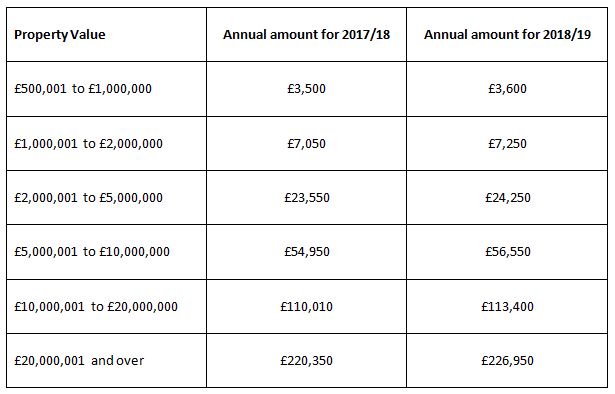
ATED rates
The ATED rates for 2018/19 have been published. As usual, these have been increased by inflation as follows:
Private Client
Income Tax
The Personal Allowance will increase on 6 April 2018 to £11,850 on its way to reaching a government commitment of £12,500 by 2020.
The higher rate threshold will similarly increase to £46,350.
The Marriage Allowance claim, where 10% of unused Personal Allowance can be transferred to a spouse, is now available in cases where a spouse has died before the claim was made. Such a claim may also be backdated up to 4 years.
The ISA exemption from income tax and capital gains tax will, from 6 April 2018, be available to Personal Representatives of a deceased person thereby removing an anomaly whereby the exemption was available to a person until their death but if this took place after 3 December 2014, then their surviving spouse could benefit from 6 April 2015 onwards but not the Personal Representatives during the period of Administration of the Estate of the deceased.
The Dividend Allowance reduces from £5,000 to £2,000 from 6 April 2018.
The starting rate for savings and the ISA funding level remain unchanged at £5,000 and £20,000 respectively, whilst the Junior ISA and Child Trust Fund limit for 2018-19 will increase to £4,260.
The Lifetime Allowance for pensions will increase to £1,030,000 from 6 April 2018.
Certificates of Tax Deposits
Very surprisingly, the Government has closed the Certificates of Tax Deposit scheme whereby taxpayers could deposit funds to cover a future tax liability on an unlimited guaranteed basis with the reason given that this will make the tax system “simpler and fairer”.
EIS and VCT Reforms
There were rumours of changes to EIS and VCT rules ahead of this year’s budget, although the changes appear at first reading to be more modest than anticipated. We are yet to receive the draft legislation when the detail will become more apparent, although in the meantime the key changes are in relation to:
- VCT Eligibility
The policy objective is to ensure that VCTs focus on long-term investment in higher risk companies. This will be done by revising the eligibility criteria for VCTs. Existing investments will be grandfathered until 6 April 2018. The onus to comply with the new criteria will be upon the VCT fund managers, but investors holding VCT investments should review their holdings and contact their fund manager to ensure they continue to qualify for tax relief.
- EIS and Knowledge-Intensive Companies
From 6 April 2018, individuals investing in knowledge-intensive companies via EIS and VCT will have their limit doubled to £2m, and the companies themselves will be able to receive up to £10m in funding through EIS and VCT.
There are a few other minor amendments to EIS and VTCs, but we are not anticipating that these will affect any of our clients.
Employees: Termination Payments – Removal of Foreign Service Relief
From 6 April 2018, employees who have worked abroad but are UK resident when their contracts are terminated will no longer be able to claim foreign service relief (although the relief will still be available for seafarers). This means that they will be taxed in the same way as employees who have not worked abroad. The existing £30,000 income tax exemption continues as before.
The Statutory Residency Test will be used to determine which employees are UK resident in the tax year they receive their termination award.
Taxation of OffshoreTrusts
While not announced in the Budget, the Government have confirmed their commitment to the tax changes previously announced for offshore trusts. These include measures initially announced as part of Finance Bill 2017 but removed after pressure from the consultation group. From 6 April 2018, they will take effect and can be summarised as follows:
- Capital payments to non-UK resident beneficiaries will not reduce the capital gains tax pool of a trust, meaning that the common practice of ‘washing out’ gains so that capital payments to UK beneficiaries can be made without a further charge to UK tax will no longer be available
- Capital or income payments made to the family of a UK resident settlor will in many cases be charged to tax on the settlor rather than on the beneficiary
- Trust distributions to a non-UK resident beneficiary where there is an onward gift to a UK resident beneficiary will be deemed to be received by the UK resident beneficiary and therefore chargeable to tax in the UK
These changes are as complex as they are wide-reaching, and we would recommend that anyone with an offshore trust structure revisits any advice and planning to ensure they understand how the new rules may impact on their situation.
Other News
The Government has plans for a number of consultations to be opened in the coming months, including:
- Looking at the taxation of trusts and how this can be made “simpler, fairer and more transparent.”
- Considering reforms to the penalty system for late or missing tax returns, as well as whether to simplify penalties and interest due on late payments are repayment.
We will, as always, keep clients updated on the impact any of these consultations may have on their tax position.
Company Taxation
Employee Benefits
In a move to encourage the use of electric cars, from April 2018, there will be no benefit in kind charge on electricity that the employer provides to charge an employee’s electric vehicle.
Withholding taxes
In a (further) attempt to capture corporation tax from the likes of google and facebook, the Government is looking to implement new withholding tax obligations on royalties and certain other rights payments made to low or no tax jurisdictions. The extended withholding tax regime will apply in connection with sales to UK customers, regardless of where the payer is located.
Consultation on how this will work in practice is set to begin on 1 December 2017 with the goal of implementing the new law with effect from April 2019.
Double Tax Relief
Effective immediately, companies will be restricted in the relief of foreign tax incurred by an overseas branch, where the company has already received relief overseas for the losses of the branch against profits other than those of the branch. This will ensure that a company cannot obtain relief twice for the same loss.
Indexation Allowance
Unlike individuals, companies are still able to claim indexation allowance on the sale of certain investments which enables them to bring the initial cost of the investment up to the equivalent value today and reduce the gain on the sale.
From 1 January 2018, indexation allowance will be frozen, and companies will not be able to claim any added relief for inflation after this date. As the relief will be frozen, there is no need to bank the current allowances by making a sale as companies will still be entitled to the relief up to this point, regardless of when the actual sale takes place.
Disincorporation Relief
At Budget 2013, the Government introduced a disincorporation relief for 5 years from April 2013, which was legislated for in Finance Act 2013. The Government have confirmed that they will not be extending the relief beyond the current 31 March 2018 expiry date. So, should you wish to take advantage of this we would suggest speaking to us as soon as possible.
Research & Development Expenditure Credits
The Government is very keen to encourage companies to increase the amount of Research and Development they carry out as they see this as increasing productivity and promoting growth.
In order to incentivise companies to do this, with effect from 1 January 2018 the rate of the R&D expenditure credit will increase from 11% to 12%.
Intangible Fixed Assets: related party step up Scheme
This change to the Intangible Fixed Asset rules, which is with immediate effect, is aimed at addressing the “step-up” avoidance schemes currently used by some related parties when accounting for a non-cash disposal of Intellectual Property, for example, the sale of licensing agreements between related parties. The new rules mean that such a non-cash disposal will be treated the same as if it were sold for cash at its market value, even if the consideration is in something other than cash.
Debts owed to HMRC
Taking effect from 6 April 2019, the Government will expand the current security deposit legislation to include corporation tax and CIS deductions. Currently, this can be used by HMRC if they think that a company may not be able to meet its liabilities for future VAT payments.
HMRC has the power to require a security for the payment of VAT and this can be used particularly when a business has gone through insolvency and been sold to a new company. Security may be required in the form of cash, or through an approved financial institution such as a bank providing a guarantee.
HMRC are also actively looking to use this more often where a new company has been formed from a company that entered into a prepack administration and as a result the new entity is run by the same directors (known as a Phoenix company).
VAT
Online Platforms
Ever keen to combat the issue of VAT not being paid to HMRC when it should have been, HMRC have announced that in Spring 2018, they will make online marketplaces jointly and severally liable for any future unpaid VAT registration from sales of goods in the UK via that online marketplace. This will involve the VAT numbers for the traders being published on the online platform and checks being put in place by that online platform to ensure the VAT number is valid.
HMRC will be able to use these powers if the trader was not registered for UK VAT and the online platform should have known or did know that they should have been registered.
These rules form part of a larger HMRC drive to ensure digital platforms play their part in ensuring the traders on their platform are complying with tax law.
Construction Sector
HMRC recently carried out a consultation with stakeholders in relation to tackling fraud in construction labour supply chains. As a result, the Government will introduce a VAT domestic reverse charge system to prevent VAT losses and move the VAT obligation to the end of the chain. This will come into force on 1 October 2019 and will require businesses in the construction sector to amend their accounting processes to meet their new obligations.
Threshold
There was speculation that the Chancellor may lower the VAT registration threshold this year but he has confirmed that both the registration threshold of £85,000 and deregistration threshold of £83,000 will remain unchanged for two years from 1 April 2018.
Making Tax Digital (MTD)
As previously announced, the introduction of Making Tax Digital has also been put back, meaning for businesses over the VAT threshold MTD will become mandatory in April 2019 and even then only for VAT reporting. The Government is now saying the scope of MTD will not be widened further until April 2020 at the earliest.
Multilateral Convention To Implement Tax Treaty Related Measures To Prevent Base Erosion and Profit Shifting
A particularly poorly publicised yet highly significant change to the UK interpretation of double taxation treaties was also confirmed today.
Earlier in the year, about 70 different countries signed up to the “Multilateral Convention To Implement Tax Treaty Related Measures To Prevent Base Erosion and Profit Shifting”.
This multilateral convention is a result of the Organisation for Economic Cooperation and Development’s (OECD) project on base erosion and profit shifting (BEPS). Broadly, the multilateral convention covers the following areas:
- hybrid mismatches (e.g. entities that are transparent in one jurisdiction but not in another or entities that are dual resident);
- treaty abuse (including very wide ranging anti-treaty shopping provisions);
- permanent establishments – and in particular the artificial avoidance of permanent establishment status through the use of commissionaire arrangements and similar strategies; and
- dispute resolution.
This multilateral convention in effect drives a horse and coaches through most of the UK’s double tax treaties and will mean that, once implemented under our domestic legislation, the multilateral convention must be read as overlaying these treaties. The Autumn Budget today confirms that the multilateral convention will be brought into law in the UK from Royal Assent of the Finance Act 2018.
Anti-Avoidance
Disguised Remuneration – a further update!
In what the Government expect to be the final changes to the disguised remuneration rules (for the time being, at least!), two further changes have been announced. Legislation on these two areas is to be published on 1 December, though there is also an addition to the existing gateway test legislation published with today’s budget papers. This draft clause is to be treated as having come into force on 29 November 2017 but will be retrospective in its effect (specifying its application to payments made at any time, including before 6 April 2011). The draft clause essentially brings into law the Supreme Court decision on the Rangers case where earnings were redirected to another individual or trust. In the Rangers case, employees entitled to income from the football club were given the option to divert these funds and receive them as trustee for the benefit of themselves or their family members. The club maintained that this diverted income was not taxable, but ultimately lost at the Supreme Court.
The Chancellor proposes to introduce a separate ‘gateway test’, which determines whether employees are subject to the provisions of the disguised remuneration rules, for employees and directors who have a “material interest” in their close company employer. The new gateway test will apply from 6 April 2018.
The second proposal is for a charge on loans caught by the disguised remuneration rules and which remain outstanding on 5 April 2019. Employees benefitting from loans relating to an offshore employer will be liable for this charge. Furthermore, there will be a requirement for both employed and self-employed individuals to provide information to HMRC by 1 October 2019 about the disguised remuneration loan. One would hope that the disclosure could be made on the individual’s tax return, although advisors and taxpayers alike may have to consider yet another HMRC login and another reporting requirement.
EBTs will be in the Government’s cross-hairs for some time to come, it would seem.
Extending offshore Time Limits
Assessment time limits for non-deliberate offshore tax non-compliance will be extended so that HMRC can always assess at least 12 years of back taxes without needing to establish deliberate non-compliance, following a consultation in spring 2018.
Off-Payroll Working
Following the success (read: increased revenue) resulting from the introduction of rules requiring public sector bodies to determine if an off-payroll worker should be treated as an employee and operate PAYE on their invoices, the Chancellor announced – unsurprisingly – that he would like to roll this out to private sector employers. Those who operate through a company and invoice for their services should be aware that the invoicing and tax treatment of their current arrangement could become a good deal more complicated in the future!
CHARTER TAX CONSULTING LIMITED
11 ST JAMES'S PLACE
LONDON SW1A 1NP